
30th June 2026, A/Prof Chee L Khoo

We have waited for a very long time. We only have one second generation long-acting basal insulin even though degludec have been available overseas for ≥ 10 years now. Insulin degludec (iDeg), in combination with a prandial insulin (insulin aspart) has been available in Australia as Ryzodeg® since 2018. But iDeg on its own? Nope. Well, my secret sources tell me that the situation is about to change soon. It will be available on the PBS very very soon (see latest below). Maybe for type 1 diabetes only. Maybe for type 1 and type 2 diabetes. So, what is iDeg? Is it a big deal?
We all remember the discovery of insulin more than 100 years ago in 1921. The discovery was a watershed moment when diabetes changed from a certain death sentence to a manageable disease. Of course, early insulin preparations were very short acting and patients require multiple injections. Protamine-enhanced insulin hexamer and zinc-enhanced lente insulin were developed to prolong the release of insulin and its activity in 1936 (1,2).
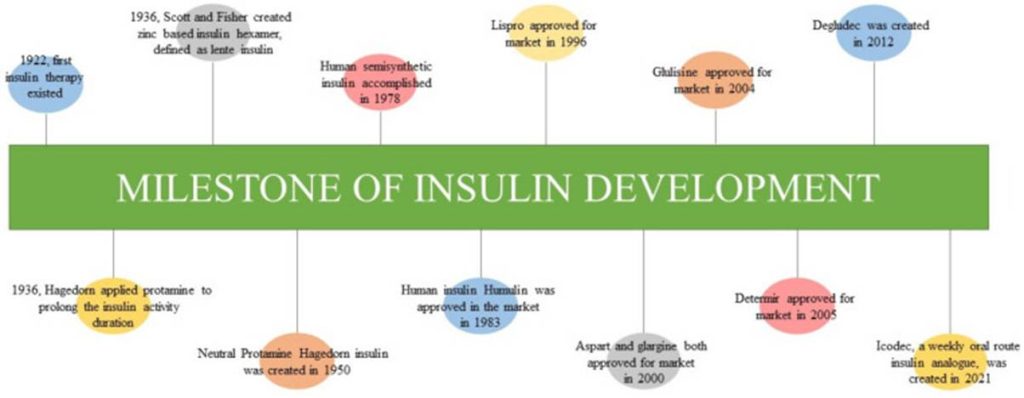
These two approaches were the basis of neutral protamine Hagedorn (NPH) insulin. Along came the long acting basal insulin analogs to provide a constant, minimal insulin secretion level and stabilize the blood sugar level between meals and overnight. This is particularly crucial in patients with T1D.
Insulin glargine (branded as Lantus) was the first basal insulin analogue marketed in 2000. It was developed via the insulin modification of two additional arginine molecules at the C-terminus of the B chain and A21 glycine modification (3). These modifications affect its solubility in the subcutaneous tissue allowing the action to be around 24 hours.
Another long-acting insulin, insulin determir bind to albumin as a result of B29 lysine—myristic acid modification. This modification prolongs its activity through slow release from the albumin (4,5). Detemir was approved for the market in June 2005 (6).
Things were hotting up and iDeg (Tresiba) was launched in 2016. It had two alterations: (1) the removal of B chain threonine in position 30 and (2) the attachment of 16-carbon fatty diacid (hexadecenoic diacid) on the B-chain lysine in position 29 through glutamate acylation. These permit the formation of multi-hexamers and appear as a depot complex in the subcutaneous layer. The multihexamers transformed into monomers which bind to albumin and then are slowly and continuously absorbed by the bloodstream (7,8).
So, how good is insulin degludec?
Because the drug has been available for > 10 years overseas now, there aren’t many new clinical trials over the last few years. It has well and truly proven itself as a very safe and efficacious long acting basal insulin. Most of the clinical trials looking at the efficacy of iDeg were done with treat to target intention, the HbA1c achieved will be pretty equivalent between iDeg and insulin glargine.
Pharmacodynamic profiles
NPH takes 1–3 h to take effect, 6–10 h to achieve peak activity has a duration of action of 14–24 hours. Insulin glargine U100 takes 1–2 h to take effect, is relatively peakless and has a duration of action of supposedly 24 h but in practice, there it kind of run out of puff at the 18-20 hour mark. Insulin glargine U300 also takes 1–2 h to take effect, is peakless and has a duration of action of 36 hours. iDeg also takes 1 hour to take effect, is also pretty peakless and has a duration of action of 36-42 hours.
We know that insulin glargine U300 is a better basal insulin because of its flatter pharmacodynamic profile than insulin glargine U100. Earlier trials comparing insulin degludec with insulin glargine U100 expected, showed that insulin degludec had significantly less hypoglycaemic episodes and requires less dosage.
In a meta-analysis, iDeg was compared with insulin determir in T1D and insulin glargine U300 in T2D (9). From a total of 19,048 patients in 20 trials, the efficacy of HbA1c reductions were not significantly different between the basal insulins. However, the reduction in fasting (FPG) was greater with insulin degludec. Throughout the treatment periods of all of the available trials, the estimated rate ratios of overall and nocturnal hypoglycaemia were significantly decreased with iDeg compared with insulin glargine or insulin detemir in patients with T1D or T2D; the differences in the risks for severe hypoglycaemia were not significant.
In many respects, the use of iDeg is similar to that of any other basal insulin, but we must always be mindful of its very long half-life and hence the longer time required to reach steady state and assess the impact of any dose adjustments.

********Latest:
Now PBS-listed: Tresiba® for type 1 diabetes
from 1st July 2026 *******
References:
- Bliss M. The History of Insulin. Diabetes Care. 1993;16:4–7
- Hirsch I.B., Juneja R., Beals J.M., Antalis C.J., Wright E.E. The Evolution of Insulin and How it Informs Therapy and Treatment Choices. Endocr. Rev. 2020;41:733–755
- Bolli G.B., Owens D.R. Insulin glargine. Lancet. 2000;356:443–445
- Scheen A., Radermecker R., Philips J.-C., Paquot N. Le medicament du mois. L’insuline detemir (Levemir) Revue Médicale de Liège. 2005;60:814.
- Dorchy H., Sternon J. Insulin analogues: Place of detemir (levemir) Rev. Medicale de Brux. 2006;27:89–94
- Hirsch I.B., Juneja R., Beals J.M., Antalis C.J., Wright E.E. The Evolution of Insulin and How it Informs Therapy and Treatment Choices. Endocr. Rev. 2020;41:733–755
- Jonassen I., Havelund S., Hoeg-Jensen T., Steensgaard D.B., Wahlund P.-O., Ribel U. Design of the Novel Protraction Mechanism of Insulin Degludec, an Ultra-long-Acting Basal Insulin. Pharm. Res. 2012;29:2104–2114
- Vora J., Cariou B., Evans M., Gross J.L., Harris S., Landstedt-Hallin L., Mithal A., Rodriguez M.R., Meneghini L. Clinical use of insulin degludec. Diabetes Res. Clin. Pract. 2015;109:19–31
- Dong Z, Feng J, Zhang J. Efficacy and Tolerability of Insulin Degludec Versus Other Long-acting Basal Insulin Analogues in the Treatment of Type 1 and Type 2 Diabetes Mellitus: A Systematic Review and Meta-analysis. Clinical Therapeutics, 2022; 44, 1520-1533
- Sugumar V, Ang KP, Alshanon AF, Sethi G, Yong PVC, Looi CY, Wong WF. A Comprehensive Review of the Evolution of Insulin Development and Its Delivery Method. Pharmaceutics. 2022 Jul 4;14(7):1406