
9th September 2026, A/Prof Chee L Khoo

Lipoprotein (a) (Lp(a)) is now accepted as a genetic, independent, and likely causal risk factor for cardiovascular disease (1-3). Lipid-lowering therapies does very little to Lp(a) levels. While PCSK9-directed therapies may lower Lp(a) by 20-30% the reductions are not clinically significant as some patients have 3-8 times the normal levels of Lp(a). A new generation of treatments designed to significantly reduce Lp(a) are currently in large multinational clinical trials to determine whether lowering Lp(a) can meaningfully reduce cardiovascular events. Most of the agents have prior Phase 2 trials which demonstrated Lp(a) reductions of between 85-100% but the corresponding Phase 3 cardiovascular outcome trials are yet to be published. Well, one of them just did – the HORIZON trial.
Lp(a) is a plasma lipoprotein consisting of an LDL-like particle with apolipoprotein B-100 (ApoB-100) covalently linked to apolipoprotein(a) [apo(a)]. Apo(a) is encoded by the LPA gene and contains a variable number of kringle IV type 2 (KIV-2) repeat units, which determine particle size and account for the high heritability (~80–90%) of Lp(a) plasma levels. Lp(a) levels are largely unresponsive to statins, fibrates, or lifestyle modification. At least 4 agents are in the vying to be the first to demonstrate cardiovascular benefits (see Table 1) (6).
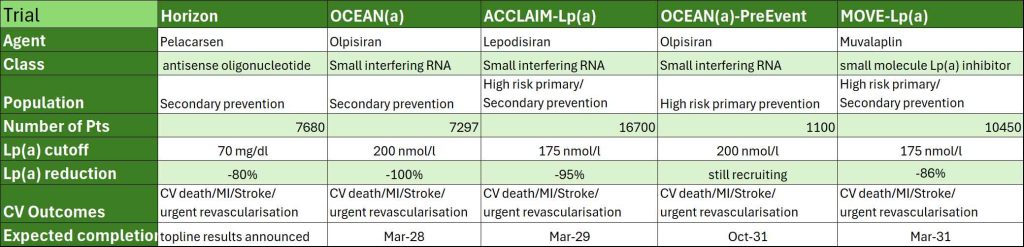
The first cab off the rank is pelacarsen in the HORIZON Phase III trial. On the 4th September Novartis announced that “the pelacarsen phase III Lp(a)HORIZON trial did not meet its primary endpoint of reducing the risk of cardiovascular events, a composite of cardiovascular death, non-fatal myocardial infarction, non-fatal stroke, and urgent coronary revascularization requiring hospitalization, compared to placebo” (4). This negative result announcement was huge news.
The full results have not been published in a peer review journal yet although it’s worthwhile examining the design, rationale and baseline characteristics of the trial (5). HORIZON is a randomised, placebo-controlled, double-blind, parallel-group, multinational trial comparing pelacarsen 80 mg subcutaneouly monthly with placebo in 8,323 patients with clinically established CVD and an elevated Lp(a) level of ≥70 mg/dL (approximately 149 nmol/L).
Participants must be aged 18-80 years old and must have previously experienced a cardiovascular event or have established cardiovascular disease (CVD) – thus, secondary prevention patients. Established CVD is defined as a history of prior myocardial infarction (MI), ischemic stroke, or symptomatic PAD. Patients are required to be on optimised standard-of-care treatments for LDL-C and other CVD risk factors (blood pressure, diabetes) according to local guidelines.
Baseline characteristics
The mean age of the trial population was 59.7 years, and 27.0% of the patients were women. 81.5% of patients had a history of MI, 9.8% a history of ischemic stroke and 14.2% symptomatic PAD. 18.1% of patients had multiple events prior to their Lp(a)HORIZON enrollment. 3,061 HORIZON patients had a history of premature MI or stroke events (defined as event occurring before 55 years of age in men and 65 years of age in women).
77.5% of the patients were taking atorvastatin ≥ 40mg or rosuvastatin ≥20 mg. 56.6% of the patients were also taking ezetimibe or bile acid binding resins, and 10.8% a PCSK9 inhibitor. The median baseline LDL-C of the patients was 1.7 mmol/L. 86.8% of patients met their individually set target of systolic blood pressure (SBP) (mean SBP: 125.3 ± 13.0 mmHg), and 91.1% met their diastolic blood pressure (DBP) target (mean DBP: 76.3 ± 8.6 mmHg) at randomisation. The median Lp(a) level at baseline was 108.3 mg/dL (235.8 nmol/L). 78.9% of patients were in the Lp(a) ≥ 90 mg/dL stratum at randomisation. You can see that the whole cohort of patients were very well look after whether they were in the pelacarsen or placebo arm.
We don’t have the full details of the study yet. No doubt, there will be a lot of discussions in the coming weeks. There will be sub-analyses after sub-analyses once the full details are out to see which sub-groups may benefit.
Perhaps….
Perhaps, setting the Lp(a) cut-off of 70 mg/dl in the HORIZON trial may not have selected the really high risk patients with elevated Lp(a) to demonstrate a significant difference although there is a sub-population where the cutoff was >90 mg/dl. Perhaps, when all the CV risk factors are so well-controlled (especially the LDL-C), the residual risks of these patients are already very low and thus, it may be difficult to demonstrate a statistically significant difference between pelacarsen and the well managed placebo group. Perhaps, much of the atherosclerotic damage has been done by the time these patients are treated with Lp(a) reducing therapies. Remember, elevated Lp(a) is a lifelong disorder. Typically, patients with elevated Lp(a) and elevated LDL-C have had these risk factors for life and 2-3 years of remediation may not be enough to demonstrate a difference.
A lot of perhaps. The other trials yet to report all have different study designs, different study populations and different Lp(a) cut-offs. Thus, we really can’t generalise the results of HORIZON to the others. Knowing the Lp(a) levels allows us to reclassify the CV risk profile of the patients and manage their risk according.
References
- Kronenberg F., Utermann G. Lipoprotein(a): resurrected by genetics. J Int Med 2013;273:6-30.
- Boffa M.B., Koschinsky M.L. Lipoprotein (a): truly a direct prothrombotic factor in cardiovascular disease? J Lipid Res 2016;57:745-757.
- Tsimikas S. A test in context: lipoprotein(a): diagnosis, prognosis, controversies, and emerging therapies. J Am Coll Cardiol 2017;69:692-711.
- https://www.novartis.com/news/media-releases/novartis-announces-lpahorizon-phase-iii-topline-results-pelacarsen-patients-elevated-lpa-and-established-cardiovascular-disease-cvd. Accessed 9th September 2026
- Leslie Cho, Stephen J. Nicholls, Børge G. Nordestgaard, et al. Design and Rationale of Lp(a)HORIZON Trial: Assessing the Effect of Lipoprotein(a) Lowering With Pelacarsen on Major Cardiovascular Events in Patients With CVD and Elevated Lp(a), American Heart Journal, Volume 287, 2025, Pages 1-9
- https://familyheart.org/lpa-clinical-trials. Accessed 9th September 2026