
21st November, A/Prof Chee L Khoo
Most of our patients with hypertension have primary (or essential) hypertension. Secondary hypertension is said to be relatively rare. Most causes of secondary hypertension are phaeochromocytoma, renal disease, renal artery stenosis, obstructive sleep apnoea, Cushing’s disease or primary aldosteronism (PA). Most of these diseases are relatively straightforward to diagnose but excluding PA is a little more tricky (see below) and we tend not to chase after that. We were taught that when we see a patient with resistant hypertension and hypokalaemia, we should think about PA. How often is hypokalaemia present in the PA? Is PA really rare?
Aldosterone is a steroid hormone produced in the adrenal zona glomerulosa. Aldosterone binds to mineralocorticoid receptor (MR) on the distal tubes or collecting ducts of the kidney, colonic mucosa, and sweat glands. After binding to the MR, aldosterone then translocates into the nucleus. In the kidneys, it activates the production of the amiloride-sensitive epithelial sodium channel to increase sodium reabsorption. This results in increased volume load. This process is accompanied by potassium excretion to obtain a balanced electrochemical gradient.
Aldosterone also binds to endothelial cells, vascular smooth muscle cells and cardiomyocytes. Here it causes oxidative stress, endothelial dysfunction, inflammation, and fibrosis in the walls of vessels or the heart (1). The increased volume load, the vasoconstriction and the dysfunction of the arteries may have direct cardiovascular effects.
The main factors inducing the production of aldosterone are angiotensin II and a elevated serum potassium. PA is mainly caused by adrenal gland adenomas or bilateral idiopathic hypertrophy of the adrenal glands. There are also rare conditions related to PA including unilateral hypertrophy, familial hyperaldosteronism (types I–IV), aldosterone-producing carcinoma, and ectopic aldosterone production (2).
PA is not just about resistant hypertension. PA patients have a high rate of cardiovascular (CV) events (3-6). Patients with PA more often experience myocardial infarction, heart failure, or stroke, and have a higher prevalence of atrial fibrillation (AF), independent of their blood pressure (BP) (3,5,7,8). Compared to age-, sex- and degree of BP-matched patients with essential hypertension, patients with PA frequently show significant left ventricular hypertrophy (LVH0 (5,6) and increased aortic stiffness (4). Thus, even if PA is relatively rare, it is still worth screening for because of the significant adverse effects if we miss.
Screening?
PA has been thought to be a rare cause of hypertension, and screening was limited to patients with hypertension and hypokalaemia, considered as essential signs of PA. PA is the most common cause of secondary hypertension with a prevalence of 5–10% in hypertensive patients (9). Hypertension in patients with PA is usually moderate to severe, and hypokalaemia only occurs in 28% of PA patients (10). Therefore, a hypertensive patient with normokalaemia should not be excluded from PA screening (11,12), and the degree of hypertension should be taken into account while screening for PA. Further, young people (age < 35 years) who have persistent and significant hypokalaemia but are not hypertensive can still have PA.
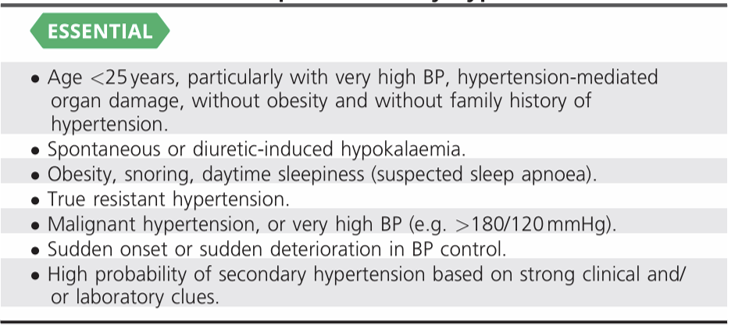
Who should we screen for PA?
The table below suggest who may have to investigate for secondary hypertension.
How do we screen?
Diagnosing of PA is complex and consists of three main assessments:
- Case detection: ARR ratio assessment.
- Confirmatory testing: the oral sodium loading test, the saline infusion test, the fludrocortisone suppression test, or the captopril challenge test.
- Subtype classification: adrenal CT imaging and adrenal vein sampling.
I will only concentrate on the ARR ratio assessment as the rest is generally, in the specialist domain. The ARR is the ratio of plasma aldosterone to plasma renin activity. The circulating concentration of aldosterone is low compared with other steroid hormones; thus, the measurement of aldosterone is difficult and may be challenging. High-performance liquid chromatography and tandem mass spectrometry measurement is currently considered the optimum assessment technique for the measurement of aldosterone (and indeed many other hormones.
The measurement of renin levels is even more complicated because of two different possible markers—plasma renin activity (PRA) and direct renin concentration (DRC). PRA reflects enzymic activity, which is measured as the amount of angiotensin I generated from angiotensinogen over a period of time (in ng/mL/h). The DRC involves the direct measurement of the plasma renin concentration (usually in pg/mL).
Neither of these methods is perfect because accuracy is variable at low renin levels. Some authorities consider that the most promising solution to this issue is the measurement of angiotensin II as a direct factor regulating aldosterone synthesis [37]. Therefore, in the near future, the aldosterone/angiotensin ratio may be used to detect instances of PA.
Performing the ARR
- Aldosterone and renin samples should be collected in the morning after the patient has been out of bed for at least 2 h, and seated for 5 to 15 min directly before the blood sample collection
- Hypokalaemia, if present should be corrected for a minimum of 24 h
- A few days before the test, the patient should discontinue any low-sodium diet, and mineralocorticoid antagonist (MRA) and other diuretics should be discontinued at least four weeks before testing.
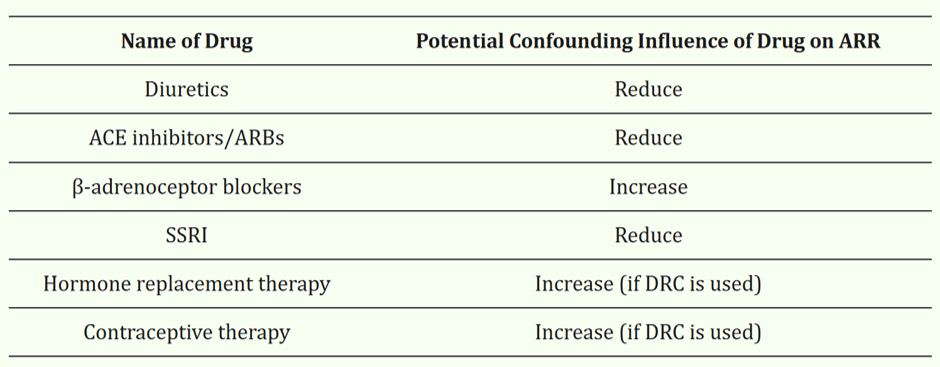
Many drugs (mainly anti-hypertensive drugs) may interfere with the ARR, causing false positive or false negative results (see Table 1).
If the patient has an aldosterone level > 0.33 nM/dm3 and an ARR (with PRA) > 30 ng/mL/h or an ARR (with DRC) > 2.5 mU/L, the screening is positive. Time to refer the patient on.
Management?
Surgery is the optimal method of treatment for patients with APA or unilateral adrenal hyperplasia. The ideal method of surgery is laparoscopic adrenalectomy. Pharmacological treatment of PA is indicated for patients with BIH and also for patients with the unilateral form of the disease who cannot undergo surgery. Pharmacological treatment is based on mineralocorticoid receptor antagonists. 4 months ago here.
Currently, only two drugs of this type are available—spironolactone and eplerenone although the new aldosterone synthase inhibitors (baxdrostat and lorundrostat) will be coming soon. We previewed baxtrostat
References:
- Callera G.E., Montezano A.C.I., Yogi A., Tostes R.C., He Y., Schiffrin E.L., Touyz R.M. C-Src—Dependent Nongenomic Signaling Responses to Aldosterone Are Increased in Vascular Myocytes from Spontaneously Hypertensive Rats. Hypertension. 2005;46:1032–1038
- Todesco S., Mantero F., Terribile V., Guarnieri G.F., Borsatti A. Ectopic Aldosterone Production. Lancet. 1973;302:443
- Milliez P., Girerd X., Plouin P.F., Blacher J., Safar M.E., Mourad J.J. Evidence for an Increased Rate of Cardiovascular Events in Patients with Primary Aldosteronism. J. Am. Coll. Cardiol. 2005;45:1243–1248.
- Ambrosino P., Lupoli R., Tortora A., Cacciapuoti M., Lupoli G.A., Tarantino P., Nasto A., Di Minno M.N.D. Cardiovascular Risk Markers in Patients with Primary Aldosteronism: A Systematic Review and Meta-Analysis of Literature Studies. Int. J. Cardiol. 2016;208:46–55
- Savard S., Amar L., Plouin P., Steichen O. Cardiovascular Complications Associated With A Controlled Cross-Sectional Study. Hypertension. 2013;62:331–336.
- Stowasser M., Sharman J., Leano R., Gordon R.D., Ward G., Cowley D., Marwick T.H. Evidence for Abnormal Left Ventricular Structure and Function in Normotensive Individuals with Familial Hyperaldosteronism Type I. J. Clin. Endocrinol. Metab. 2005;90:5070–5076.
- Manolis A., Doumas M. Atrial Fibrillation, Arterial Hypertension, and Primary Aldosteronism: A Dangerous and Unexpected Trio. J. Hypertens. 2020;38:208–210
- 27.Hundemer G.L., Vaidya A. Primary Aldosteronism Diagnosis and Management: A Clinical Approach. Endocrinol. Metab. Clin. North Am. 2019;48:681–700
- Young W.F. Diagnosis and Treatment of Primary Aldosteronism: Practical Clinical Perspectives. J. Intern. Med. 2018;285:126–148
- Monticone S., Burrello J., Tizzani D., Bertello C., Viola A., Buffolo F., Gabetti L., Mengozzi G., Williams T.A., Rabbia F., et al. Prevalence and Clinical Manifestations of Primary Aldosteronism Encountered in Primary Care Practice. J. Am. Coll. Cardiol. 2017;69:1811–1820
- Strauch B., Zelinka T., Hampf M., Bernhardt R., Widimsky J. Prevalence of Primary Hyperaldosteronism in Moderate to Severe Hypertension in the Central Europe Region. J. Hum. Hypertens. 2003;17:349–352.
- 33.Rossi G.P. Primary Aldosteronism: JACC State-of-the-Art Review. J. Am. Coll. Cardiol. 2019;74:2799–2811
- Ekman N, Grossman AB, Dworakowska D. What We Know about and What Is New in Primary Aldosteronism. Int J Mol Sci. 2024 Jan 11;25(2):900