
28th November 2026, A/Prof Chee L Khoo

Not very often do you have two new drugs in the same class being approved by the TGA within the one month. In the last issue of GPVoice we previewed oral wegovy and anticipated its commercial availability within weeks. This week, the other oral GLP1 also became available commercially. That is orforglipron, a small-molecule, non-peptide GLP1-RA which we briefly previewed 15 months ago here. Just like we did with oral wegovy last fortnight, we will do a deep dive into all you need to know about orforglipron, marketed as Foundayo®.
Because orforglipron is not a peptide, it doesn’t get digested in the stomach. It is a synthetic, orally bioavailable, nonpeptide agonist of the GLP-1 receptor that was rationally designed to overcome the intrinsic limitations of peptide-based GLP-1 RAs, particularly poor oral bioavailability and rapid enzymatic degradation. It also means it doesn’t have to be taken in an empty stomach with minimal sips of water like we have to with oral wegovy. It mimics the actions of glucagon-like peptide-1 (GLP-1) for reducing food intake and lowering blood glucose levels. Just like the oral wegovy, orforglipron was trialled in patients with diabetes (the ACHIEVE series) and in patients who are overweight or obese but with no diabetes (the ATTAIN series). Let’s get familiar with orforglipron in those two populations of patients.
At the pancreatic level, cAMP-mediated signalling enhances glucose-dependent insulin secretion from β-cells while suppressing inappropriate glucagon release from α-cells, thereby reducing both fasting and postprandial glycemia. In the gastrointestinal tract, orforglipron slows gastric emptying, attenuating the rate of glucose absorption and blunting postprandial glucose excursions. In parallel, central nervous system penetration enables engagement of hypothalamic and brainstem circuits involved in appetite regulation and satiety, leading to reduced caloric intake and clinically meaningful weight loss.
Peak plasma concentrations are typically achieved within 2–4 h, and oral bioavailability is approximately 30–40%. Food intake has minimal impact on systemic exposure, providing flexibility for administration in real-world settings.
How efficacious is orforglipron in reducing glucose?
Mechanistic biomarker analyses revealed enhanced β-cell function, improved insulin sensitivity, and reductions in fasting glucagon, supporting the dual pancreatic and central mode of action. These results indicate that orforglipron not only lowers glucose but may also preserve or restore β-cell responsiveness, a key determinant of long-term diabetes progression.
There has been a number of Phase 3 trials comparing orforglipron to a number of glucose lowering agents (see Table 1 below).
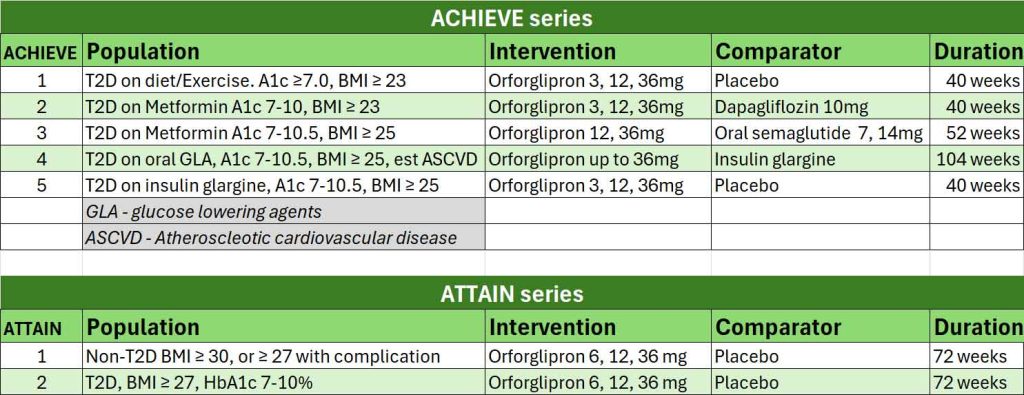
The ACHIEVE-1 trial assessed orforglipron in early T2D inadequately controlled early T2D patients despite lifestyle interventions (1). Over 40 weeks, treatment resulted in substantial reductions in HbA1c (~1.24 –1.48% vs -0.4%) without significant hypoglycaemia [27].
In ACHIEVE-2 trial in patients with inadequately controlled T2D on metformin, orforglipron was compared with dapagiflozin 10mg (2). Over 40 weeks, orforglipron superior HbA1c reduction (-1.23 to -1.56% vs – 0.42%).
In ACHIEVE-3 trial in patients with inadequately controlled early T2D on metformin, orforglipron (9, 12mg) was compared with oral semaglutide (7, 14mg) (3). Over 52 weeks, orforglipron 12mg and 36mg were superior to oral semaglutide 7mg and 14mg (HbA1c reduction (-1.71 and -1.9% vs – 1.23 and -1.47%).
The ACHIEVE 4 trial was about cardiovascular safety of orforglipron. Patients with T2D on up to 3 oral glucose lowering agents and established cardiovascular disease were randomised to either orforglipron up to 36mg or insulin glargine over 24 months (4). Orforglipron demonstrated non-inferiority to insulin glargine for 4 point major adverse cardiovascular events (MACE-4). As an added bonus, clinically significant or severe hypoglycaemia was statistically lower in the orforglipron (6.8% vs 19.2%).
In the ACHIEVE-5 trial, patients with T2D on insulin glargine were randomised to either orforglipron or placebo (5). Orforglipron was superior to placebo in reducing HbA1c (-1.58% with 3mg, -1.82% with 12mg and -1.79% with 36mg) over 40 weeks.
The most frequent adverse events with orforglipron in these trials were gastrointestinal (mild to moderate).
Thus, orforglipron was efficacious in reducing HbA1c in patients with T2D whether they were early T2D on diet/exercise, on metformin, SGLT2 inhibitors or insulin. It appears to be more efficacious than oral semaglutide. It also demonstrated cardiovascular safety.
How efficacious is orforglipron in weight loss?
The ATTAIN program further evaluated the efficacy of orforglipron for weight management in both diabetic and non-diabetic populations.
ATTAIN-1 enrolled overweight or obese adults without diabetes (6). Over 72 weeks, orforglipron yielded mean weight loss of -7.5%, – 8.4% and -11.2% with 6, 12 and 36 mg respectively. Among the patients in the orforglipron 36-mg group, 54.6% had a reduction of 10% or more, 36.0% had a reduction of 15% or more, and 18.4% had a reduction of 20% or more, as compared with 12.9%, 5.9%, and 2.8% of the patients, respectively, in the placebo group. Waist circumference, systolic blood pressure, triglyceride levels, and non-HDL cholesterol levels significantly improved with orforglipron treatment as compared with placebo.
ATTAIN-2 enrolled participants with T2D and BMI ≥27 (7). Over 72 weeks, orforglipron yielded mean weight loss of -7.5%, – 8.4% and -11.2% with 6, 12 and 36 mg respectively.
There were other ATTAIN clinical trials that has just reported:
ATTAIN-MAINTAIN was a double-blind, placebo-controlled trial clinical trial investigating the switch from injectable incretin-based therapy to an oral GLP-1 agonist for the maintenance of body weight reduction (8). It randomised participants previously treated with injectable tirzepatide or semaglutide during the SURMOUNT-5 study to orforglipron once daily or placebo.
Participants treated with orforglipron demonstrated significant and clinically meaningful maintenance of body weight reduction achieved with injectable therapy compared with placebo, with 75% and 79% in the orforglipron group versus 49% and 38% in the placebo group in the tirzepatide and semaglutide cohorts respectively.
Just like the other oral GLP which we preview last fortnight, oral orforglipron is efficacious in HbA1c reduction (up to – 1.9% in the ACHIEVE-3 trial) as well as efficacious in weight reduction (up to -11.2% in the ATTAIN 1) in patients with or without T2D. Orforglipron is also useful in weight loss maintenance after weight loss from injectables incretins. As a bonus, weight loss with orforglipron is associated with improvement in cardiovascular risk factors.
References
- Rosenstock J, Hsia S, Nevarez Ruiz L, Eyde S, Cox D, Wu WS, Liu R, Li J, Fernández Landó L, Denning M, Ludwig L, Chen Y; ACHIEVE-1 Trial Investigators. Orforglipron, an Oral Small-Molecule GLP-1 Receptor Agonist, in Early Type 2 Diabetes. N Engl J Med. 2025 Sep 18;393(11):1065-1076.
- Welch M, Forst T, Jia W, Del Pino PO, Denning M, Wu WS, Li J, Liu R, Eifu M, Chen Y; ACHIEVE-2 Trial Investigators. Orforglipron compared with dapagliflozin in adults with type 2 diabetes and inadequate glycaemic control with metformin (ACHIEVE-2): a multicentre, randomised, non-inferiority, open-label, phase 3 trial. Lancet. 2026 Jul 11;408(10550):125-140.
- Rosenstock J, Yabe D, Cox D, Li J, Denning M, Wu WS, Liu R, Zhao Y; ACHIEVE-3 Investigators. Efficacy and safety of once-daily oral orforglipron compared with oral semaglutide in adults with type 2 diabetes (ACHIEVE-3): a multinational, multicentre, non-inferiority, open-label, randomised, phase 3 trial. Lancet. 2026 Mar 21;407(10534):1147-1160.
- Klein K, Wysham C, Tuttle K et al. Cardiovascular safety of orforglipron versus insulin glargine in adults with type 2 diabetes at increased cardiovascular risk (ACHIEVE-4): a phase 3, event-driven, randomised, open-label, non-inferiority, active comparator trial. The Lancet, 2026; 408, 1557-1570
- Giorgino F, D’Souza S, Ludwig L, et al. Orforglipron Added to Titrated Insulin Glargine in Type 2 Diabetes: The ACHIEVE-5 Randomized Clinical Trial. JAMA. 2026;336(5):389–399.
- Wharton S, Aronne LJ, Stefanski A, Alfaris NF, Ciudin A, Yokote K, Halpern B, Shukla AP, Zhou C, Macpherson L, Allen SE, Ahmad NN, Klise SR; ATTAIN-1 Trial Investigators. Orforglipron, an Oral Small-Molecule GLP-1 Receptor Agonist for Obesity Treatment. N Engl J Med. 2025 Nov 6;393(18):1796-1806.
- Horn D, Ryan D, Kis S et al. Orforglipron, an oral small-molecule GLP-1 receptor agonist, for the treatment of obesity in people with type 2 diabetes (ATTAIN-2): a phase 3, double-blind, randomised, multicentre, placebo-controlled trial. The Lancet, 2025; 406, 2927-2944
- Aronne, L.J., Horn, D.B., le Roux, C.W. et al. Orforglipron for maintenance of body weight reduction: the double-blind, randomized phase 3b ATTAIN-MAINTAIN trial. Nat Med 32, 2679–2687 (2026)